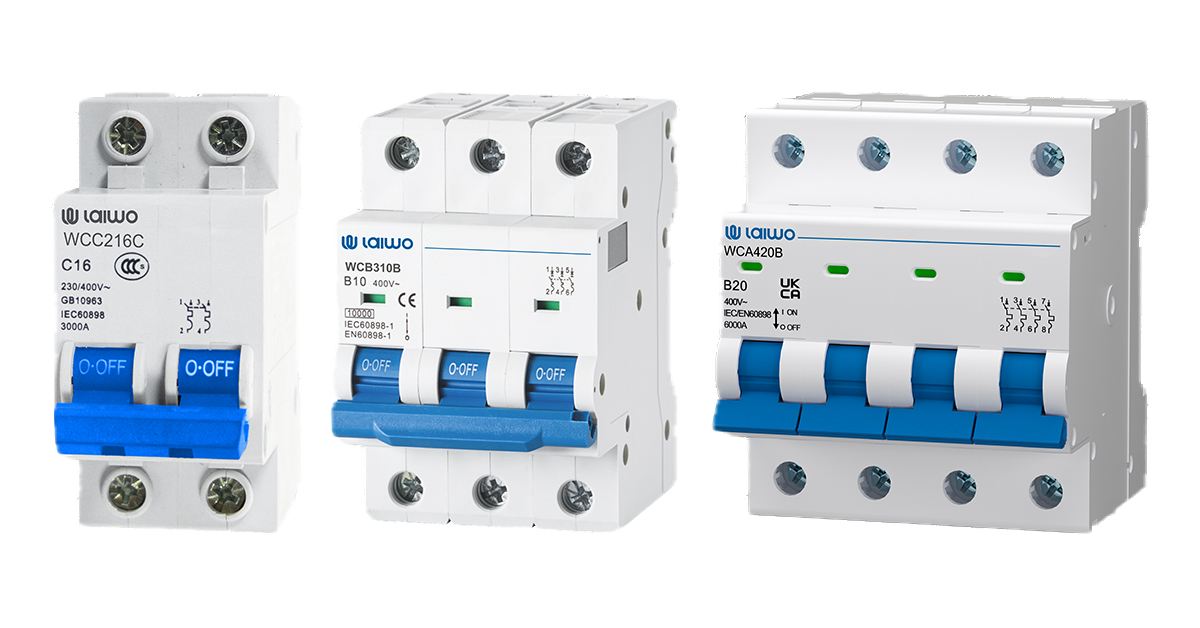
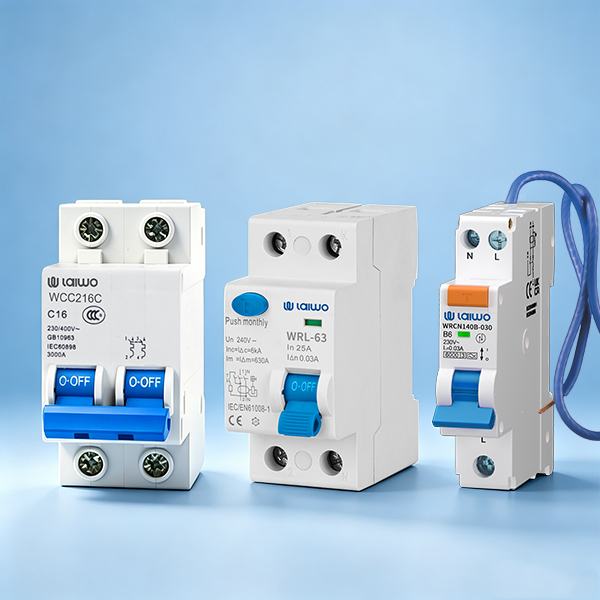
- Current rating alone does not define an MCB.
- Trip curve must suit the expected inrush behaviour.
- Breaking capacity must be checked against prospective fault current.
- Market approval and exact model scope should be verified before purchase.
Rated current and conductor protection
The MCB rating should be selected as part of the circuit design, taking account of conductor capacity, expected load and applicable installation rules. A higher current number is not an upgrade if it weakens protection of the connected cable.
Trip curve and load behaviour
Loads with motors, transformers or other inrush characteristics may need a different instantaneous trip response from ordinary resistive circuits. The buyer should state the application so the supplier can identify the available curve range and documentation.
What B, C and D actually mean
The letter sets the instantaneous magnetic trip band as a multiple of rated current. B trips between three and five times In, C between five and ten, and D between ten and twenty. Everything else about the device can be identical.
The practical consequence is nuisance tripping at one end and slow disconnection at the other. A C-curve breaker on a resistive lighting circuit will hold, but it also needs more fault current to trip fast; a B-curve breaker on a transformer or motor circuit will trip on inrush that is not a fault at all.
- B (3-5 In) — resistive loads and circuits with low prospective fault current
- C (5-10 In) — general distribution and lighting with higher switch-on current
- D (10-20 In) — transformers, motors and other high-inrush equipment
Poles and switching arrangement
- Number of protected poles
- Neutral switching requirement
- Module width and distribution-board compatibility
- Terminal position, tightening information and accessories
Breaking capacity and approval scope
The stated breaking capacity should be checked at the relevant voltage and against the exact product standard. Ask for the approved datasheet and certificate schedule so the model, rating and market claim can be matched.
Matching breaking capacity to the board
Breaking capacity is not a quality ranking, it is a match to the prospective fault current at the point of installation. A 10kA device on a domestic final circuit is not safer than a 6kA one, it is more expensive.
Ranges are usually built around this split, so it is worth deciding early: it determines which series you are ordering from, not just which reference within a series.
- 3kA — domestic and light commercial where prospective fault current is low
- 6kA — the general-purpose case for most residential and light-commercial work
- 10kA — commercial boards and supplies close to the transformer
Final product selection must be checked against the project design, destination-market requirements and the approved manufacturer documentation for the exact model.