
Identify the charger requirement
Record charger phase, load, connection method and manufacturer installation requirements.
EV distribution equipment should be selected as part of the charger installation, with attention to enclosure, residual-current protection, surge exposure and destination-market rules.
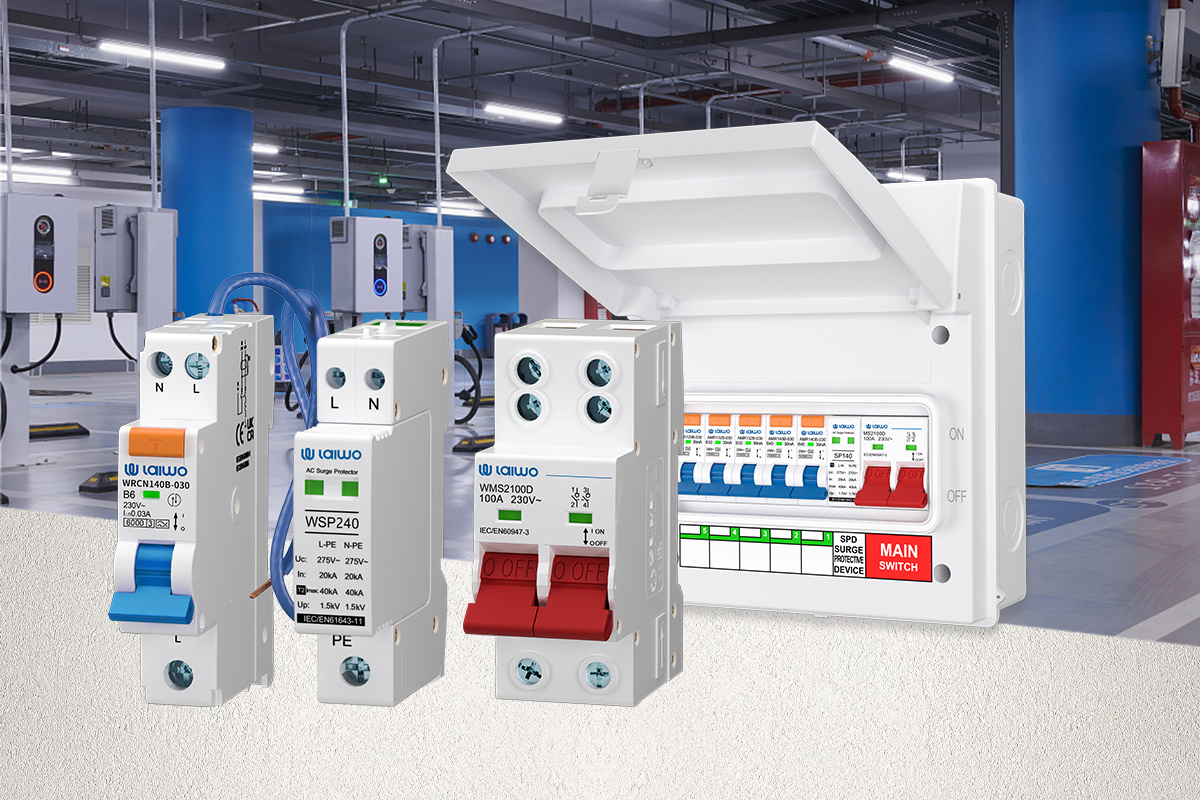
An EV charging site rarely means a single charger. Multiple charge points have to be distributed, protected against overload and earth leakage, shielded from surges, and kept working in an outdoor or semi-outdoor environment — all as one coordinated system.
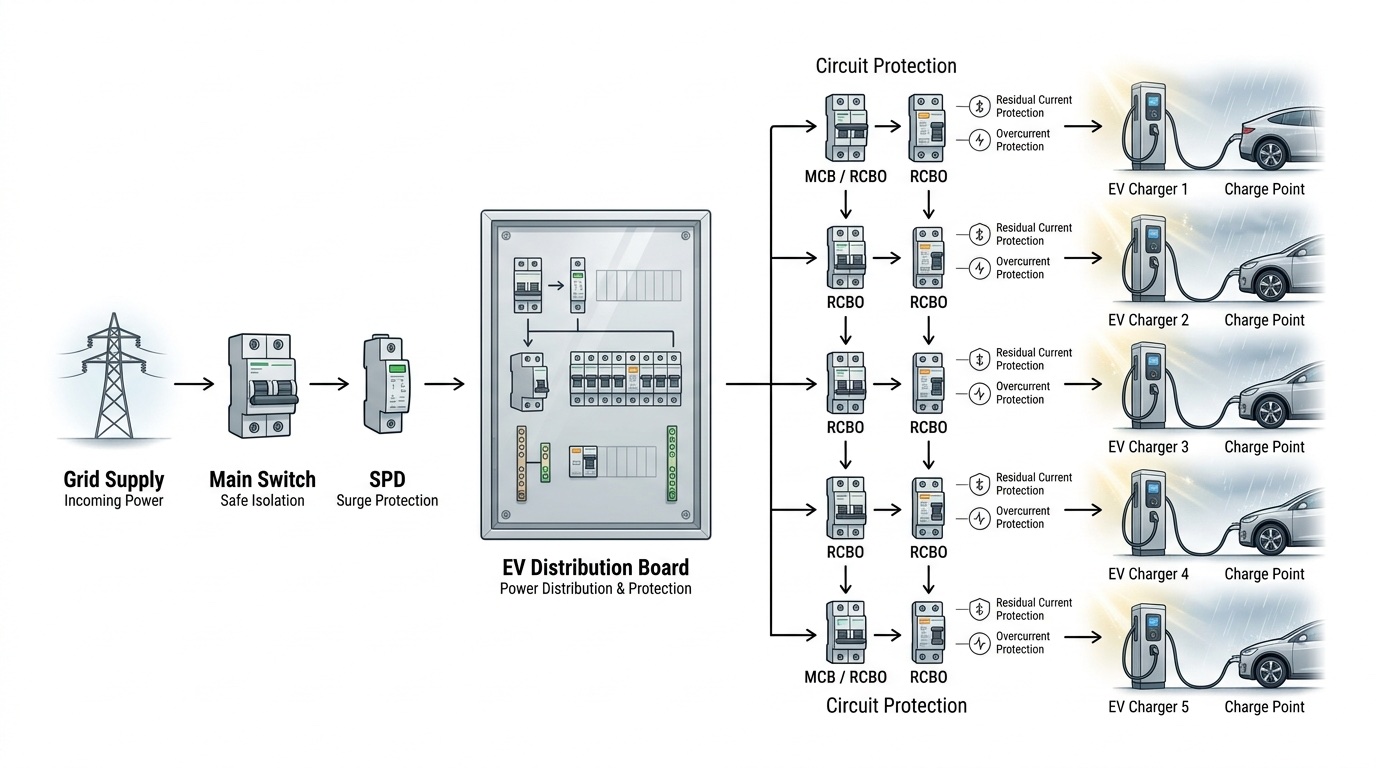
LAIWO can supply the full device set for an EV charging distribution system from one manufacturer, with the application logic mapped to each protection function. Final device selection stays aligned with the charger manufacturer's instructions and the installation design.
| Project requirement | LAIWO solution |
|---|---|
| Distribution | EV Distribution Box |
| Overcurrent | MCB |
| Leakage | RCCB / RCBO |
| Surge | SPD |
| Isolation | Main Switch |
| Outdoor | IP-rated Enclosure |
An EV consumer unit or garage board cannot be specified safely from the number of ways alone. Charger characteristics, upstream protection, earthing arrangement, residual-current protection, surge protection and installation environment all influence the final solution.
LAIWO provides a product path for weather-resistant enclosures and matching protective devices. Final device selection must remain aligned with the charger manufacturer’s instructions, installation design and applicable local requirements.
Each stage reduces ambiguity before samples, technical review and quotation.
Record charger phase, load, connection method and manufacturer installation requirements.
Define overcurrent, residual-current and surge-protection needs as part of the complete circuit design.
Match ways, mounting, cable entry and environmental protection to the actual installation location.
Request the relevant model data, wiring information, declarations and private-label requirements.
Include charger phase and load, installation location, earthing information, required protective devices, number of ways, quantity, destination market and desired OEM scope.
No. The required device type and functionality depend on the charger, system design and local installation requirements. Confirm the exact arrangement for the project.
Branding, labels, packaging and populated configurations can be reviewed as part of an OEM programme after the base model is selected.
Choose the resource or sales route required for the next stage of product evaluation.
Review the existing product range before choosing a model or configuration.
Open downloads → 02 · VerifyTell us the model and market so sales can match the relevant document scope.
Request documents → 03 · EvaluateShare the product, rating, quantity and evaluation target for a sample discussion.
Discuss samples → 04 · SourceSend model, quantity, destination and OEM scope for a structured response.
Start an inquiry →